The Age of Strongmen and the Test of Wisdom
This essay examines the global rise of strong leadership and the growing temptation toward control. Through the inclusive philosophy of Sanatan Dharma, it presents a vision of leadership rooted in wisdom, balance, and collective growth rather than domination.
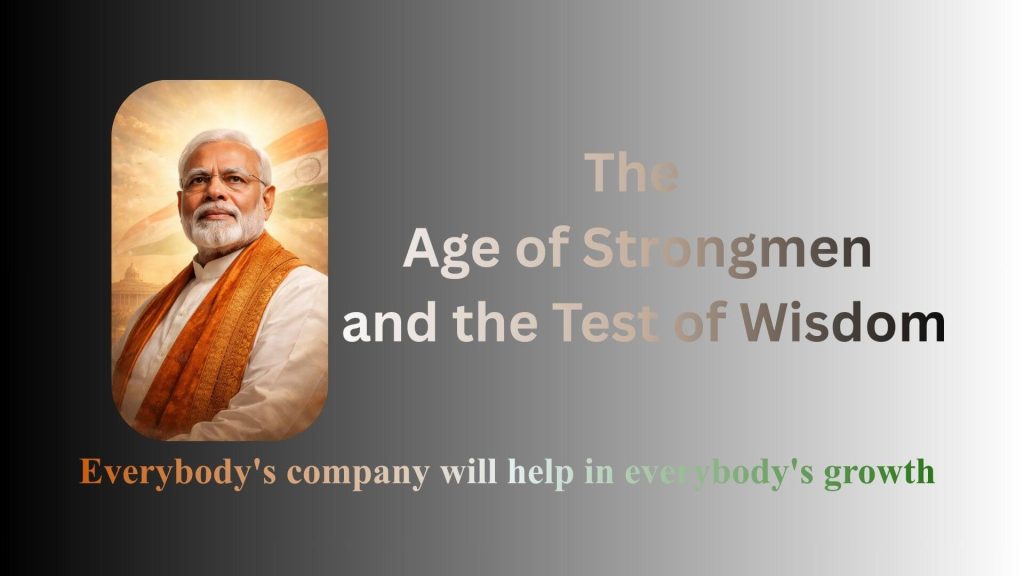
“Leadership rooted in continuity, tested by wisdom.”
Introduction: Power at a Crossroads
Across the modern world, leadership stands at a delicate threshold. Democracies, born from the promise of collective voice and shared responsibility, increasingly display a tension between authority and accountability. Many contemporary leaders appear drawn toward centralization of power- sometimes out of fear, sometimes out of ambition, and often out of the pressure to deliver rapid results in a complex, impatient world. To observe this trend is not merely to criticize individuals, but to understand a deeper global condition: governance today is navigating anxiety, fragmentation, and identity crises.
Within this atmosphere, the question is not simply who governs, but from what inner philosophy governance arises. Leadership shaped by insecurity tends toward control. Leadership shaped by civilizational confidence tends toward inclusion.
The Global Drift Toward Centralization
Modern prime ministers and presidents operate under relentless scrutiny-24-hour media cycles, polarized electorates, economic instability, and geopolitical uncertainty. In such conditions, the temptation to consolidate power may appear as an efficiency measure. Decision-making becomes faster, dissent becomes inconvenient, and uniformity masquerades as unity.
This is not always born of malice. Often, it is fear: fear of chaos, fear of losing relevance, fear of being unable to hold together societies that feel increasingly divided. Yet history consistently shows that when leadership seeks dominance over dialogue, governance slowly drifts away from democracy and toward authoritarian patterns- sometimes subtly, sometimes openly.
Inclusion as an Antidote to Authoritarianism
True inclusion does not arise from political slogans or surface-level representation. It arises from a worldview that sees diversity not as a threat, but as an organic reality. Leaders who genuinely value pluralism do not merely tolerate differences; they recognize them as essential expressions of collective life.
In this sense, inclusion is not a political strategy- it is a civilizational instinct.
Narendra Modi and the Civilizational Lens
Narendra Modi’s leadership is often interpreted through the lens of development, nationalism, and reform. Yet at a deeper level, his approach can be examined as civilizational rather than merely political. His repeated emphasis on cultural roots, historical continuity, and collective identity reflects an understanding that governance is sustained not only by policy, but by shared meaning.
Unlike leaders who attempt to erase differences in the name of control, Modi’s stated vision emphasizes participation across communities and religions within a broader cultural framework. This approach does not demand sameness; instead, it seeks coherence- a sense that diverse traditions can coexist without losing their distinctiveness.
Sanatan Dharma: A Framework of Plural Unity
Sanatan Dharma, often misunderstood as a rigid religious system, is in essence a fluid civilizational philosophy. It does not insist on a single prophet, a single book, or a single path to truth. Its core insight is profoundly inclusive: Truth is vast, and human access to it is necessarily diverse.
Within this worldview:
- Multiple philosophies can coexist without canceling one another.
- Faith and reason are not enemies, but companions.
- Spiritual diversity is not disorder; it is a natural expression.
A leader who understands Sanatan Dharma does not seek domination over belief systems. Instead, such a leader recognizes that society thrives when individuals are allowed to root themselves deeply while respecting others’ roots.
Respect Versus Instrumentalization
A crucial distinction must be made between using culture and respecting it. When culture is instrumentalized, it becomes a tool of control. When it is respected, it becomes a source of strength and restraint.
Modi’s appeal to Sanatan values- discipline, service, continuity, and duty- can be interpreted as an attempt to anchor governance in ethical memory rather than transient political gain. In this view, leadership is not an act of personal dominance, but of custodianship.
Leadership Beyond Dictatorship
Dictatorship emerges when a leader sees themselves as indispensable. Civilizational leadership emerges when a leader sees themselves as a conduit- one moment in a much longer historical flow.
The Sanatan perspective inherently resists dictatorship because it emphasizes cycles rather than absolutes, duty rather than entitlement, and responsibility rather than ego. When governance aligns with these principles, authority is naturally tempered by humility.
Conclusion: The Deeper Question of Power
The world’s current fascination with strong leaders reveals not only political trends but a collective search for stability. Yet stability achieved through coercion is fragile. Stability achieved through shared roots is resilient.
Narendra Modi’s leadership, when viewed through the lens of Sanatan Dharma, represents an attempt- whether fully realized or still evolving- to govern through inclusion grounded in civilizational confidence rather than fear-driven control. In a time when many leaders flirt with authoritarian impulses, this philosophical orientation offers an alternative path: leadership that draws strength from plurality, continuity, and respect for the many ways human beings seek meaning.
Ultimately, the future of democracy may depend less on constitutions and more on consciousness- on whether leaders rule from insecurity or from understanding.

Shaheer Sehyogi
Harjinder Kaur is a writer and seeker whose works reflect spirituality, self-awareness, and the art of living. She writes from direct experience, turning life’s questions into meditative reflections that awaken wonder.